
Medicare vs. Medicare Advantage: Understanding Your Options and Choosing the Right Coverage
What seniors and their families need to know about Medicare coverage, enrollment deadlines, and making informed decisions about healthcare.
Choosing Medicare coverage is one of the most important healthcare decisions older adults face. Yet, for many seniors and their families, understanding the differences between traditional Medicare and Medicare Advantage can be confusing. Television commercials, insurance agents, and mail solicitations often emphasize the additional benefits of Medicare Advantage plans, but those benefits don't necessarily make them the best choice for everyone.
The right Medicare coverage depends on your health, financial circumstances, preferred physicians, prescription medications, lifestyle, and anticipated healthcare needs.
With Medicare's annual Open Enrollment Period currently underway, now is an excellent time to review your coverage and determine whether your existing plan remains the best option.
Let's look at four important questions to help you make an informed decision.
1. What Is the Difference Between Traditional Medicare and Medicare Advantage?
Although both options provide Medicare coverage, they work quite differently.
Traditional Medicare (Original Medicare)
Traditional Medicare, also called Original Medicare, is the federal health insurance program administered by the Centers for Medicare & Medicaid Services (CMS).
It consists of two primary components:
Medicare Part A (Hospital Insurance): Helps cover inpatient hospital stays, skilled nursing facility care (when eligibility requirements are met), hospice care, and certain home healthcare services.
Medicare Part B (Medical Insurance): Covers physician visits, outpatient services, preventive care, laboratory testing, medical equipment, and other medically necessary services.
People enrolled in traditional Medicare can also purchase:
Medicare Part D: Separate prescription drug coverage offered through private insurance companies.
Medigap (Medicare Supplement Insurance): Supplemental insurance that helps pay certain out-of-pocket expenses, including deductibles, copayments, and coinsurance.
One of the biggest advantages of traditional Medicare is freedom of provider choice. Beneficiaries can generally see any physician, specialist, or hospital in the United States that accepts Medicare.
In most circumstances, referrals to see specialists are not required, and prior authorization is not necessary for most covered services.
However, traditional Medicare does not have an annual out-of-pocket spending limit. Without supplemental insurance or other coverage, beneficiaries can face substantial expenses, particularly when they have significant healthcare needs.
Medicare Advantage (Medicare Part C)
Medicare Advantage is an alternative to traditional Medicare. These plans are offered by private insurance companies that contract with Medicare to provide Medicare-covered benefits.
Medicare Advantage plans must cover medically necessary services covered by Medicare Parts A and B, but they may establish different cost-sharing arrangements and rules for accessing care.
Most Medicare Advantage plans combine:
Hospital coverage (Part A).
Physician and outpatient coverage (Part B).
Prescription drug coverage (Part D).
Many plans also advertise additional benefits, such as:
Dental care.
Vision examinations and eyewear.
Hearing examinations and hearing aids.
Gym memberships or fitness programs.
Transportation to medical appointments.
Certain over-the-counter health products.
One appealing feature is that some Medicare Advantage plans advertise $0 monthly premiums beyond the required Medicare Part B premium.
However, a $0 premium does not mean healthcare is free. Beneficiaries may still have copayments, deductibles, coinsurance, and other out-of-pocket expenses.
Another important distinction is that Medicare Advantage plans generally operate through provider networks. Depending on the plan, beneficiaries may be required to use specific physicians, hospitals, laboratories, and other healthcare providers.
Some plans also require referrals or prior authorization before certain services, procedures, or treatments are approved.
Unlike traditional Medicare, Medicare Advantage plans have an annual maximum out-of-pocket limit for covered Medicare services. Once that limit is reached, the plan covers the full cost of covered services for the remainder of the year.
A Side-by-Side Comparison
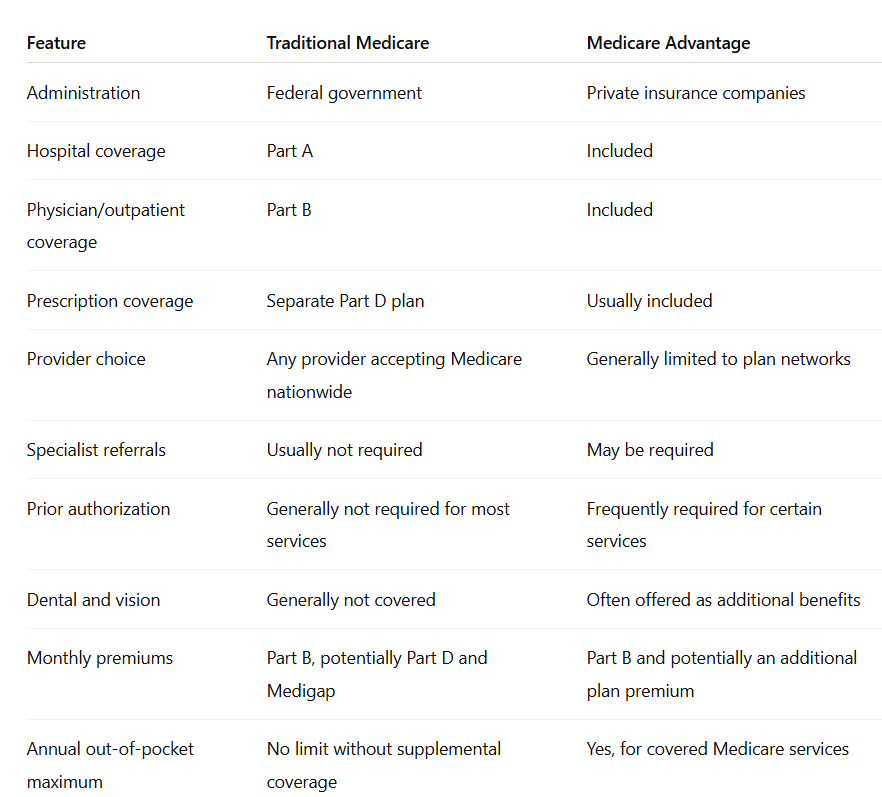
Neither option is automatically better. The important question is which provides the best combination of access, coverage, and financial protection for your individual circumstances.
The official Medicare comparison is available at Medicare.gov: Compare Original Medicare and Medicare Advantage.
2. What Circumstances Might Make Traditional Medicare a Better Fit?
Medicare Advantage plans can be attractive, particularly for relatively healthy individuals who want additional benefits and are comfortable receiving care within a defined provider network.
However, there are several circumstances in which traditional Medicare may be a better choice.
You Have Multiple Chronic Medical Conditions or Complex Healthcare Needs
Individuals managing multiple chronic conditions often require care from several specialists, advanced diagnostic services, frequent hospitalizations, or specialized treatment programs.
Traditional Medicare may offer greater flexibility when coordinating care among multiple providers.
For example, someone receiving treatment for cancer, heart disease, kidney disease, or neurological conditions may want unrestricted access to specialists and major medical centers without worrying about whether those providers participate in a particular insurance network.
This flexibility can become especially important when a patient's condition changes or requires highly specialized treatment.
You Want Greater Freedom to Choose Your Physicians and Hospitals
One of the most significant differences between traditional Medicare and Medicare Advantage is provider access.
With traditional Medicare, you can generally see any physician or use any hospital nationwide that accepts Medicare.
With Medicare Advantage, you generally need to use providers within your plan's network for routine care, although some PPO plans offer out-of-network coverage at a higher cost.
This distinction matters if:
You have longstanding relationships with particular physicians.
Your preferred specialists do not participate in certain Medicare Advantage networks.
You receive care from specialists in multiple healthcare systems.
You live in one state but frequently receive medical care in another.
You want the flexibility to seek a second opinion at a major medical center.
For seniors who travel frequently or divide their time between multiple residences, traditional Medicare may offer a significant advantage.
You Want to Minimize Prior Authorization Requirements
Prior authorization is a process through which an insurance company must approve certain medical services, procedures, medications, or treatments before they are provided.
Although prior authorization is not unique to Medicare Advantage, it is an important consideration when comparing coverage options.
Medicare Advantage plans may require prior authorization for certain services, including advanced imaging, procedures, rehabilitation services, and some specialty treatments.
This can introduce additional administrative steps into the delivery of care.
For individuals with complex medical conditions, these requirements may create additional challenges when timely access to healthcare services is important.
Traditional Medicare generally has fewer prior authorization requirements.
You Anticipate Frequent Hospitalizations or Need Specialized Post-Acute Care
This is an especially important consideration for older adults.
After hospitalization, seniors may require:
Skilled nursing facility rehabilitation.
Physical, occupational, or speech therapy.
Home healthcare.
Specialty physician consultations.
Ongoing medical monitoring.
Both traditional Medicare and Medicare Advantage cover qualifying services, but the way coverage is administered can differ.
Traditional Medicare generally allows beneficiaries to receive covered services from any participating Medicare provider, while Medicare Advantage plans may have network restrictions and additional authorization requirements.
For someone who anticipates needing rehabilitation or other post-acute services, it is important to understand which skilled nursing facilities and rehabilitation providers participate in a particular Medicare Advantage plan.
The ability to access a preferred facility can make a meaningful difference in the transition from hospital to home.
You Want More Predictability in Your Healthcare Coverage
Traditional Medicare combined with a Medigap policy can offer considerable financial predictability.
Depending on the Medigap policy selected, much of the deductibles and coinsurance associated with traditional Medicare may be covered.
This combination can be particularly appealing to individuals who:
Have substantial healthcare needs.
Want to minimize unexpected medical expenses.
Prefer flexibility in choosing physicians and hospitals.
Have the financial resources to pay the additional monthly premiums.
It is important to remember that Medigap policies have separate enrollment rules. Outside certain guaranteed-issue protections, insurance companies may be able to medically underwrite applicants in many states.
Consequently, someone considering switching from Medicare Advantage to traditional Medicare should investigate their ability to obtain supplemental coverage before making that change.
An important consideration: Traditional Medicare is not necessarily less expensive than Medicare Advantage. Part B premiums, Part D premiums, Medigap premiums, and other expenses must all be considered. The goal is to evaluate the total cost of healthcare, not simply the monthly premium.
3. When Does Medicare Open Enrollment End? Can You Change Plans Outside of Open Enrollment?
Medicare has several enrollment periods, and understanding the differences is essential.
Annual Medicare Open Enrollment: October 15 – December 7
The Annual Open Enrollment Period occurs every year from October 15 through December 7.
For 2026, Open Enrollment ends December 7, 2026.
During this period, beneficiaries can:
Switch from traditional Medicare to Medicare Advantage.
Switch from Medicare Advantage to traditional Medicare.
Change from one Medicare Advantage plan to another.
Enroll in, change, or discontinue a Medicare Part D prescription drug plan.
Changes generally become effective January 1 of the following year.
This is an important opportunity to evaluate whether your current coverage still meets your needs.
Insurance companies can change their premiums, deductibles, copayments, prescription formularies, provider networks, and additional benefits from one year to the next.
Even if you are satisfied with your current coverage, you should review your plan's Annual Notice of Change (ANOC) before deciding to keep it.
Medicare Advantage Open Enrollment: January 1 – March 31
There is another important enrollment opportunity specifically for people already enrolled in Medicare Advantage.
Between January 1 and March 31, beneficiaries enrolled in Medicare Advantage can:
Switch to a different Medicare Advantage plan.
Discontinue Medicare Advantage and return to traditional Medicare.
Enroll in a separate Medicare Part D prescription drug plan if they return to traditional Medicare.
This enrollment period is not available to people currently enrolled in traditional Medicare who want to switch to Medicare Advantage.
Generally, beneficiaries can make one change during this period.
Special Enrollment Periods: When You May Qualify to Change Plans Outside of Open Enrollment
Many people mistakenly believe they must wait until October 15 to December 7 to change their Medicare coverage.
However, certain life circumstances allow beneficiaries to enroll in or switch Medicare plans outside the annual Open Enrollment Period.
These are called Special Enrollment Periods (SEPs).
Examples include:
1. Moving to a new residence
If you move outside your Medicare Advantage plan's service area or to an area where additional plan options are available, you may qualify for a Special Enrollment Period.
2. Losing employer-sponsored or other health insurance
Individuals who lose employer or union health coverage may qualify for an opportunity to enroll in Medicare coverage or make changes to their existing plans.
3. Becoming eligible for Medicaid
Individuals who qualify for both Medicare and Medicaid may have additional opportunities to change their Medicare coverage.
4. Qualifying for Extra Help
Extra Help is a federal program that assists eligible individuals with Medicare prescription drug expenses. Qualifying for Extra Help may provide additional opportunities to change prescription drug coverage.
5. Moving into or out of a nursing home or other qualifying institution
Individuals who move into, reside in, or move out of certain qualifying institutions may have additional enrollment opportunities.
6. Other exceptional circumstances
There are additional circumstances that may qualify someone for a Special Enrollment Period, including certain situations involving misleading enrollment information or significant changes to a plan's provider network.
The timing and options available depend on the specific circumstances.
The important takeaway is that you do not necessarily have to wait until the next annual Open Enrollment Period to make a change.
If you believe you qualify for a Special Enrollment Period, contact Medicare directly or speak with a State Health Insurance Assistance Program (SHIP) counselor to determine your eligibility.
Official information is available at Medicare.gov: Special Enrollment Periods.
4. What Are Reputable Resources to Help Seniors Choose the Best Medicare Plan?
Choosing Medicare coverage can be overwhelming. Fortunately, several reputable organizations provide objective information and assistance.
I encourage seniors and their families to use independent resources rather than relying exclusively on insurance company advertisements or sales representatives.
Here are several excellent places to start.
1. Medicare.gov — The Official Medicare Website
This should be the first stop for anyone comparing Medicare coverage.
The website offers:
Side-by-side comparisons of Medicare Advantage and Part D plans.
Information about premiums, deductibles, and out-of-pocket expenses.
Provider and pharmacy network information.
Prescription drug coverage comparisons.
Medicare Advantage plan quality ratings.
Enrollment information and deadlines.
The Medicare Plan Finder is particularly useful because it allows beneficiaries to compare available plans based on their geographic location, prescription medications, pharmacies, and healthcare preferences.
You can also call Medicare directly at 1-800-MEDICARE (1-800-633-4227).
2. State Health Insurance Assistance Program (SHIP)
SHIP National Technical Assistance Center
SHIP is one of the most valuable resources available to Medicare beneficiaries and their families.
These programs provide free, individualized, unbiased Medicare counseling.
SHIP counselors can help seniors:
Understand the differences between Medicare coverage options.
Compare Medicare Advantage and prescription drug plans.
Understand Medigap coverage.
Review healthcare costs.
Identify programs that may help pay Medicare expenses.
Navigate enrollment opportunities.
Importantly, SHIP counselors are not insurance salespeople. Their role is to help beneficiaries understand their options and make informed decisions.
For Texas residents:
The Texas Health Information, Counseling and Advocacy Program provides Medicare counseling through the state's SHIP program.
Call 800-252-9240 for assistance.
Additional information is available through the Texas Department of Insurance.
3. Medicare Rights Center
The Medicare Rights Center is a nonprofit organization dedicated to helping older adults and people with disabilities understand and navigate Medicare.
Its resources include:
Medicare education.
Enrollment guidance.
Information about coverage denials and appeals.
Assistance understanding Medicare rights and protections.
Educational materials for caregivers and family members.
Its Medicare Interactive website is another particularly helpful resource for individuals who want to understand complicated Medicare rules.
Visit Medicare Interactive.
4. Kaiser Family Foundation (KFF)
KFF is a nonprofit organization that conducts independent research and analysis on healthcare policy.
Its Medicare publications provide useful information about:
Differences between traditional Medicare and Medicare Advantage.
Medicare spending and healthcare costs.
Trends in Medicare Advantage enrollment.
Access to healthcare services.
Policy changes affecting Medicare beneficiaries.
KFF is particularly helpful for seniors and family members who want a deeper understanding of how Medicare works and how changes in the healthcare system may affect them.
5. State Department of Insurance
Your state's Department of Insurance can provide valuable information about Medicare Supplement (Medigap) policies and insurance consumer protections.
For Texas residents, the Texas Department of Insurance provides information about:
Medicare Supplement insurance.
Insurance company complaints.
Consumer protections.
Medigap enrollment rights.
This is especially important for individuals considering switching from Medicare Advantage to traditional Medicare because access to Medigap coverage may be limited depending on the circumstances.
Final Thoughts: The Best Medicare Plan Is the One That Meets Your Healthcare Needs
Medicare decisions should not be based solely on television advertisements, promises of additional benefits, or the appeal of a $0 monthly premium.
The most important considerations are whether your physicians and preferred hospitals are accessible, whether your medications are covered, how much you will pay when you need healthcare, and whether your insurance will provide the flexibility you need as your health changes.
For some seniors, Medicare Advantage may be an excellent option, particularly when their preferred physicians participate in the network and the plan offers meaningful additional benefits at an affordable cost.
For others, traditional Medicare combined with a Medigap policy may provide greater flexibility, more predictable healthcare expenses, and fewer restrictions on accessing specialists and medical services.
I would encourage every Medicare beneficiary to consider the following questions before making a decision:
Are my current physicians and preferred hospitals included in the plan's network?
Are all my prescription medications covered, and what will they cost?
What are my total anticipated healthcare expenses, including premiums, deductibles, copayments, and coinsurance?
Will I have access to the specialists and healthcare facilities I may need in the future?
What happens if I develop a serious medical condition or require hospitalization, rehabilitation, or skilled nursing care?
If I change my mind about Medicare Advantage, will I be able to obtain a Medigap policy?
That last question deserves particular attention. Although Medicare beneficiaries can generally switch between traditional Medicare and Medicare Advantage during eligible enrollment periods, obtaining a Medigap policy after leaving Medicare Advantage is not always guaranteed.
Remember: Medicare coverage is not a one-size-fits-all decision. Taking the time to understand your options, evaluate your anticipated healthcare needs, and seek unbiased guidance can help ensure that you have the coverage that best protects your health, finances, and access to care.
With Open Enrollment ending December 7, 2026, now is the time to review your options and make an informed decision about your healthcare coverage for 2027.
Disclaimer: This article is intended for educational and informational purposes and should not be considered individualized insurance, financial, or legal advice. Medicare coverage, costs, enrollment rights, and plan availability vary by individual circumstances and geographic location. Consult Medicare, a SHIP counselor, or a qualified insurance professional before making coverage decisions.
Editorial note: Medicare rules and enrollment dates in this article reflect information available as of November 11, 2026. The dates are particularly important because this article is written for the current 2026 Open Enrollment Period and 2027 coverage year.
Curated with the assistance of ChatGPT.